Longbarrow Press rounds off its thirteenth year of activity with a review of the events, projects and publications of 2018:
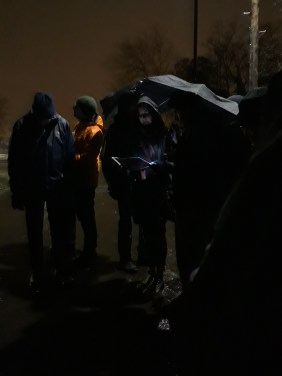 #1 January. ‘As we reach the last barrier the light abandons the lane. Almost darkness, almost silence.’ We start the year with a night walk through north Sheffield, led by poets
Angelina D’Roza, Pete Green, Chris Jones and Fay Musselwhite, tracking the River Don from Owlerton to Neepsend on one of the coldest nights of the season. The route is retraced in an essay by Brian Lewis
(illustrated with Emma Bolland‘s photographs from the walk), which also
examines some of the ideas and exchanges that informed the event, and the culture and literature of urban walking. Click here to read ‘Night Walk #1: Owlerton’ on the Longbarrow Blog.
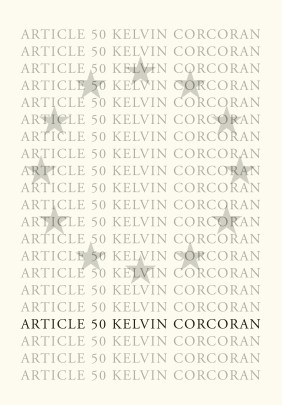 #2 February. ‘To write a mythology / commensurate to an ignorant island / is not difficult. / They were of that class of traitor /
self-serving, unimaginative.’ The publication of Article 50, a hand-stitched pamphlet by Kelvin Corcoran, in which ‘the current self-destructive politics of the UK and its implausible actors are set alongside those things worth living for: music, friendship and poetry itself.’ Article 50 is acclaimed by Charlie Connelly in The New European as ‘the best articulation of the post-Brexit shock and fallout’, and by Ian Brinton as a ‘beautifully produced little book [that] should be read by anyone who values lyric poetry’. Click here to read a sample poem from Article 50 (and to order the pamphlet).
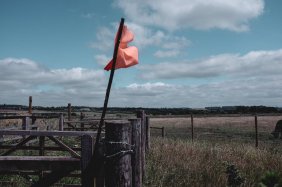 #3 March. Two posts on the Longbarrow Blog explore the shallow, porous pockets of ‘rurban’ South Yorkshire and the glens and lochs of Western Scotland. In the first of these, Brian Lewis revisits Adwick Washlands, a deindustrialised flood plain that forms part of the RSPB’s landscape portfolio, its ‘movable frontiers of land and water’ softening its borders with estates and farmland. The contours of the old landscape are glimpsed on a walk through the wetland (led by Lewis and Matthew Clegg on National Meadows Day), animated by skylarks and wodwos, the tensions between managed paths and feral trails, and the discovery of a swallow’s nest in the concrete chamber of an anti-aircraft gun site. Click here to read ‘Open to the Sky’. In the second post, Mark Goodwin recounts a journey through the glens and lochs of Western Scotland in the wake of ‘days of snow and ice’, soundtracked by ‘some unidentified bird’, as the year’s first flush of light and heat is felt, and spring unfurls ‘its newest of oldest gestures’. You can read ‘Matter’ here.
#4 May. ‘We don’t see the catastrophe, only the shifts of light and perspective, the horizon scrolling between sea and sky, the distance sharpened or softened by cloud.’ In a further essay for the Longbarrow Blog, Brian Lewis considers the relationship between our communication networks and the spaces in which they operate; a theme developed in J.R. Carpenter‘s multimedia work The Gathering Cloud, in which a cultural history of the skies informs an extended meditation on the discreet, complex and expanding ecosystem of ‘cloud computing’. Click here to read ‘Rain, Steam and Speed’.
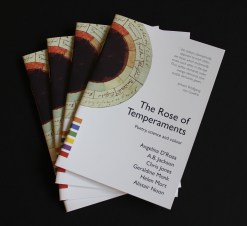 #5 June. The publication and launch of The Rose of Temperaments, a pamphlet featuring six colour-themed sonnets by Angelina D’Roza, A.B. Jackson, Chris Jones, Geraldine Monk,
Helen Mort and Alistair Noon (in their original and ‘recoloured’ versions), reflections on art, poetry and semiotics by project curators Paul Evans and
Brian Lewis, and essays on science and colour perception by The University of Sheffield’s
Richard Jones and Tony Ryan.
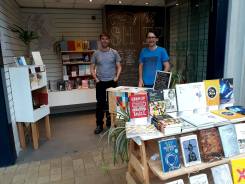 #6 July. And Other Stories, Longbarrow Press and The Poetry Business embark on a two-week residency in Sheffield’s Winter Garden as SHIP (Sheffield Independent Publishers). The pop-up shop is run as a collective endeavour, and, as well as offering an opportunity to browse and buy poetry, fiction, translated and international literature from the three publishers, creates a forum for informal, friendly exchanges with the reading public.
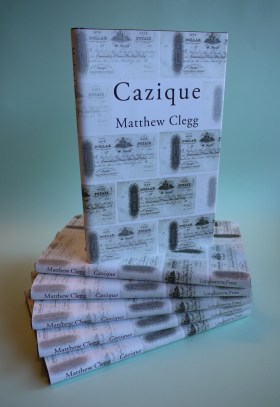
‘The state of happiness we call a fool’s paradise is based on a person’s not knowing or denying the existence of potential trouble.’ The relationship between deception and self-deception informs almost every page of Cazique, Matthew Clegg‘s third full collection. In ‘The Outside Inside: Some Notes on Creative Practice’, he discusses the role of the ‘conman’ – historical, contemporary, imaginary – in shaping its title sequence. Click here
to read the essay.
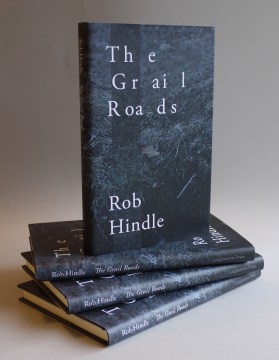 #7 September. ‘Around Ypres, over the border in Belgium, farmers call it the Iron Harvest. Each year their ploughs uncover munitions, barbed wire, remnants of rifles. Sometimes the flotsam of older conflicts turns up – lead and iron from the Napoleonic Wars and the Hundred Years’ War.’ Rob Hindle previews The Grail Roads (his third full-length collection, and his first with Longbarrow Press) with a timely reflection on nationalism, empire, myth, and his own route through the ‘cultural archaeology’ of western Europe. Click
here to read ‘The Iron Harvest’. The Grail Roads reimagines the ‘quest’ of Galahad, Gawain, and other knights of Arthurian legend, displaced from their familiar mythology and recast as British soldiers on the Western Front. As the war turns attritional, the vision of the Grail darkens; one by one, the men are gathered into a dream of ‘a first and final home’ beyond the wrecked landscapes. The book is hailed by Charlie Connelly as ‘a beautiful piece of work, a masterpiece […it] is, by some distance, my book of 2018.’
 I’ve had my share of boom and bust,
and now the times have bottomed out
I’m the Cazique of Mexborough –
mucky St Helena of my mind.
I have a plan and all I need
is half of everything you own.
#8 October. Matthew Clegg‘s engagement with personae and place goes deeper, and darker, with the publication of Cazique, his third collection. Its title sequence hinges on the last confessions of a washed-up confidence trickster: a man inspired by the 19th-century swindler Gregor MacGregor – the self-titled Cazique of Poyais. This ‘Cazique’ is ‘part anti-hero, part trickster, and part fallen angel – a genie of deception and self-deception’.
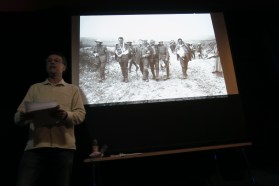 #9 November. The Grail Roads is launched at DINA, Sheffield, on the centenary of the Armistice that ended the First World War. A specially devised performance (in which Rob Hindle is supported by Matthew Clegg and Ray Hearne) distils the collection’s pathos and drama in the intimate setting of the Jara Room.
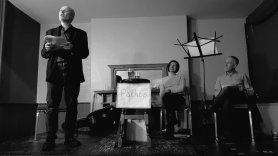 Our final event of the year is the launch of Matthew Clegg‘s Cazique at The Shakespeare, Sheffield, with a three-act performance led by Clegg and punctuated by spoken, sung and strummed interventions by Angelina D’Roza, Pete Green, Ray Hearne, and Fay Musselwhite.
Our thanks to everyone who has supported the press over the last 12 months; we return in 2019 with a new series of projects, publications and events, including titles by Angelina D’Roza, Nancy Gaffield, Mark Goodwin and Peter Riley. Further details will be posted in the new year.
Photographs: Emma Bolland, Nikki Clayton, Brian Lewis, Marianthi Makra, Dominic Somers

 Longbarrow Press marks the new year with two new publications. The first of these is Rock as Gloss, Mark Goodwin’s sixth full-length collection, and his second with Longbarrow Press (following 2014’s Steps). Divided into four ‘compasses’, its 184 pages offer a variety of approaches to ‘the rock in hand’ (whether gritstone or slate) or the fell under foot (whether on or off the map). Available from 31 January, it is launched in Sheffield on Thursday 7 February with a special performance at The Shakespeare (admission free, all welcome). Visit the Rock as Gloss microsite for further information about the book and the launch event.
 Our second publication of 2019 is Meridian by Nancy Gaffield. Between 2015 and 2017, the author of Tokaido Road walked the 270-mile Greenwich Meridian Trail from Peacehaven to Sand le Mere, in order to investigate the way that landscapes are disturbed and reordered by history and memory. In Meridian, the line of longitude is the ‘zero point’ through which these forces speak: the intersecting planes of poetry and song, politics and the polis, land and sea, presence and absence, shadow and light. It is published on 8 February, and launched in Canterbury on Tuesday 12 February (all welcome). Visit the Meridian microsite for further information about the book.
 A brilliant and original volume of narrative poetry… evocative and accessible, subtle and nuanced, varying in style and format to create a startlingly good piece of work that, for this writer, provides the last word on the First World War and the commemoration of the Armistice. The Grail Roads is, by some distance, my book of 2018. Charlie Connelly’s ‘year in review’ (in The New European #126) renews his acclaim for The Grail Roads by Rob Hindle. Click here to order the book with free UK P&P until the end of January. Cazique, the third collection by Matthew Clegg, is also available with free UK P&P until the end of the month; click here for further details and to order the book.
 Longbarrow Press