Rhyme all the ways a city battens down.
Say, river waters tide the roads to town.
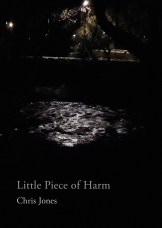
Longbarrow Press is delighted to announce the publication of Little Piece of Harm, a new pamphlet by Chris Jones.
Little Piece of Harm is a narrative sequence that focuses on 24 hours in the life of a city that has been shut down in the aftermath of a shooting. As this act of violence ramifies outwards, the sequence explores the geographical reach of Sheffield – its urban settings and its rural landmarks – and eavesdrops on the city’s conversations. Pete, the narrator, comes into contact with a variety of people who reflect on this public killing in relation to private moments of trauma and harm. Five years in the making, Jones’s first publication since Skin (Longbarrow Press, 2015) skilfully employs a range of poetic forms to drive its stories and dialogues.
A beautifully produced 40-page pamphlet, Little Piece of Harm is available now from Longbarrow Press. You can read an extract from the book here, and order it by clicking on the relevant PayPal link below (major debit cards accepted – no PayPal account required).
Little Piece of Harm £5
UK orders (+ £1.75 postage) Europe orders (+ £4.50 postage) Rest of World orders (+ £6.00 postage)
‘The more difficult it got to create sense and structure, the more pleasure I had in finding new lines of progression. You have to extract gratification from the process of composition, however stuck the needle, or else there is no point in doing the writing.’ In the second of three short essays reflecting on the themes, forms and narratives of Little Piece of Harm, Chris Jones considers ‘the “scaffolding” of rhyming structures’ and the role of this ‘scaffolding’ in developing tone and voice in the sequence. Click here to read ‘A City’s Designs’. The first essay, ‘Story Arcs and Safety Nets’, appears here; the third and final essay will appear on the Longbarrow Blog in early April.
It’s still, so still a siren floats for miles from edge of town to fields that dust the moon.
Little Piece of Harm is a narrative sequence by Chris Jones that focuses on 24 hours in the life of a city that has been shut down in the aftermath of a shooting. As this act of violence ramifies outwards, the sequence explores the geographical reach of Sheffield – its urban settings and its rural landmarks – and eavesdrops on the city’s conversations. Longbarrow Press is delighted to announce the publication of Little Piece of Harm on 25 March: click here to order the pamphlet. ‘Story Arcs and Safety Nets’, the first of three essays reflecting on the development of Little Piece of Harm, appears here. You can read a poem from the sequence here. Little Piece of Harm is launched with a Zoom event at 6.30pm on Wednesday 24 March, in which Chris will discuss and read from the pamphlet; to register, please email Harriet Tarlo at H.Tarlo@shu.ac.uk (with Little Piece of Harm in the subject field), and the Zoom link will be emailed to you.
‘It’s necessary to be surprised and challenged and, at times, fearful, otherwise there’s not much point in going on.‘ In January, Canadian editor and publisher Rob McLennan interviewed Longbarrow editor and publisher Brian Lewis for his long-running ‘small press questions’ series, tracking the evolution of the press from the ‘trial and error’ of its early, hand-made pamphlets to its most recent publications. Click here to read the interview. A few days later, Lewis took part in a discussion with writer and photographer Martyn J Bull. The first in a series of filmed encounters between artists and writers on the poetics of post-war infrastructure (organised by Manchester School of Architecture), their conversation ranged from the pipelines and turbines of the Isle of Axholme (the setting for Lewis’s recent sequence White Thorns) to the affective legacies of Didcot Power Station. You can watch the full discussion below:
light’s
tiny monuments reach
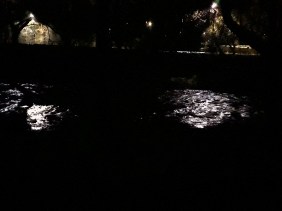
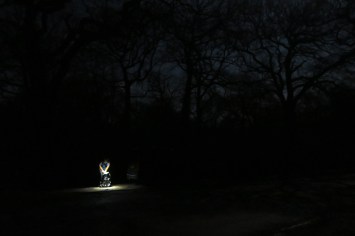
The year’s first post on the Longbarrow Blog is ‘Reach’ by Mark Goodwin & Nikki Clayton, an exploration, through photographs and short poems, of a darkened Bradgate Park in the last hours of 2020. Click here to view the post. It is followed by ‘Second Delivery’, a sequel (of sorts) to the Lockdown Walks diarised by Brian Lewis during April 2020. This ‘winter postscript’ documents the delivery route taken by Lewis – spanning north, west and south Sheffield – shortly before Christmas (and renewed lockdowns). ‘Left at the corrugated autocentre, the same flagpole, a different flag. It used to be a chequered racing flag and now it is a union flag, or half of a union flag. The other half is missing, worn away by wind, nothing more than wind.’ You can read it here. A further post by Mark Goodwin & Nikki Clayton looks back at a winter walk through Leicestershire’s medieval villages, ‘gathering’ the light laid down in ‘feathery specks’ of snow. Click here to read ‘Gather’.
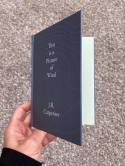
‘We all become phenologists, weathered bodies, studying the seasons to mark time passing…’ J.R. Carpenter‘s recent collection This is a Picture of Wind is the subject of an extended review by Alison Scott (for SPAM zine); click here to read it. ‘This is a work made from the past and the present and which hopefully will speak to our future.’ Steve Spence’s review of This is a Picture of Wind (for Litter) appears here. J.R. Carpenter is taking part in a number of online events in spring 2021, including art & writing in between spaces (with Elizabeth Reeder and Amanda Thomson) on Thursday 8 April (click here for tickets) and Five Bodies (with Rowan Evans and Vicky Sparrow) on Thursday 15 April (further details here).
‘Led by gravity, this river / soon trumps their vanity.’ ‘Boys on Manoeuvres’, a new poem by Fay Musselwhite, is featured on the website of the Morning Star; you can read it here.
Photographs: Emma Bolland, J.R. Carpenter, Nikki Clayton.

 Rhyme all the ways a city battens down.
 Little Piece of Harm
 Longbarrow Press